
 English


Best season for camel trekking in Merzouga comes down to one number: the roughly 20°C+ swing between Erg Chebbi’s daytime highs and nighttime lows, which varies dramatically by month (Weather-and-Climate.com). A trek that’s a pleasant sunset walk in April can be a genuinely uncomfortable ordeal in July. This guide breaks down exactly which months make for the best camel trekking and desert-camp conditions, and why — not just “best time to visit Merzouga” in general, but specifically when the trek itself, the camp experience, and the night sky are all at their best together.
For the full seasonal picture across all 12 months, see our guide to the best time to visit Merzouga.
Key Takeaways
- March–May and September–November are the best season for camel trekking in Merzouga, with daytime highs in the mid-20s to low-30s°C and manageable desert-camp nights.
- Guides schedule treks for sunrise and sunset year-round, but in summer that’s not optional — midday highs can reach 43°C (109°F), making a daytime trek genuinely risky.
- Clear, dry winter air (December–February) often gives the sharpest stargazing, but January desert-camp nights average just 6°C (43°F) — pack accordingly.
- Shoulder-season months (April, May, September, October) balance comfortable trekking with lower crowd levels at camps than peak winter holiday weeks.
- A standard trek runs about an hour each way; the season affects comfort and visibility far more than it affects trek length or difficulty.
Ready to book? See our 3-Day Marrakech to Merzouga Desert Tour.
Table of Contents
Why Season Matters More for Camel Trekking Than for a Regular Visit
A camel trek isn’t a quick photo stop — it’s roughly an hour of exposed desert travel each way, typically followed by a night in a tent with no climate control beyond blankets and a campfire. That makes the trekking-and-camping experience far more season-sensitive than, say, a short 4×4 excursion or a day trip through Merzouga town. Comfort during the ride, sleep quality at camp, and how clear the stars appear all shift substantially by month.
Spring and Autumn: The Best Season for Camel Trekking
March through May and September through November consistently offer the best combination of conditions: daytime highs in the mid-20s to low-30s°C (77–90°F), and nights that are cool but not brutal. Erg Chebbi’s climb from a 26°C (79°F) March average high to 34°C (93°F) by May, then back down from 37°C (99°F) in September to 24°C (75°F) by November, means both shoulder seasons offer a genuine window where neither trek nor camp requires serious heat or cold management (Weather-and-Climate.com).
| Season | Trekking comfort | Camp nights | Crowd level |
|---|---|---|---|
| Spring (Mar–May) | Excellent | Mild to warm | Moderate |
| Summer (Jun–Aug) | Poor (extreme heat) | Warm | Lower |
| Autumn (Sep–Nov) | Excellent | Mild | Moderate |
| Winter (Dec–Feb) | Good (cold nights) | Cold | Highest (holidays) |
Source: Weather-and-Climate.com Merzouga climate averages, cross-referenced with meteoblue’s 30-year modeled dataset.
Month-by-Month Temperature Breakdown for Trekking
Averages are useful for picking a season, but if you’re choosing between two specific months, the month-by-month numbers matter more. The table below shows Merzouga’s typical daytime high and overnight low for every month, drawn from Weather-and-Climate.com’s long-term averages and cross-checked against meteoblue’s 30-year modeled climate data — the same two sources used throughout this guide.
| Month | Avg. daytime high | Avg. overnight low | Trekking verdict |
|---|---|---|---|
| January | 19°C (66°F) | 6°C (43°F) | Good days, cold nights |
| February | 21°C (70°F) | 8°C (46°F) | Good days, cold nights |
| March | 26°C (79°F) | 12°C (54°F) | Excellent |
| April | 29°C (84°F) | 15°C (59°F) | Excellent |
| May | 34°C (93°F) | 19°C (66°F) | Good, trek at sunrise/sunset |
| June | 39°C (102°F) | 23°C (73°F) | Caution, sunrise/sunset only |
| July | 43°C (109°F) | 29°C (84°F) | High caution, sunrise/sunset only |
| August | 41°C (106°F) | 27°C (81°F) | High caution, sunrise/sunset only |
| September | 37°C (99°F) | 22°C (72°F) | Good, trek at sunrise/sunset |
| October | 30°C (86°F) | 17°C (63°F) | Excellent |
| November | 24°C (75°F) | 11°C (52°F) | Excellent |
| December | 20°C (68°F) | 7°C (45°F) | Good days, cold nights |
Read the shoulder months closely: April and October both land solidly in the “excellent” category, while May and September require nothing more than sticking to sunrise or sunset departures to stay comfortable. The real caution window is narrower than “summer” as a whole — it’s specifically late June through August, when even the early-morning temperature rarely drops below the mid-20s°C.
How This Differs From General “Best Time to Visit” Advice
General “best time to visit Merzouga” guidance usually just points at spring and autumn and stops there, because it’s trying to cover day trips, town visits, and photography all at once. This guide narrows that down specifically for the camel trek and overnight camp, because those two activities carry different constraints than a quick daytime visit: several consecutive hours of sun exposure during the ride, then a full night with no climate control beyond blankets and a fire. A month that’s perfectly fine for wandering Merzouga town at midday can still be a poor choice for a camel trek departing at the same hour.
Trekking Difficulty and Physical Comfort by Season
Camel trekking itself doesn’t require athletic fitness — you’re seated, and the pace is slow and steady across roughly an hour each way. What changes by season isn’t difficulty, it’s endurance against the elements. In peak summer, an hour in direct sun on an exposed animal, wearing whatever layers you need for sun protection, is a meaningfully different physical experience than the same hour in a mild 25°C spring afternoon. Riders with heat sensitivity, young children, or older travelers benefit most from scheduling their trek in the cooler shoulder-season months, when the margin for error is much wider.
Hydration and Heat Management on the Trek
Regardless of which season you pick, carry more water than feels necessary — OSHA and NIOSH heat-illness guidance recommends roughly a cup every 15 to 20 minutes during sustained heat exposure, which adds up to several liters across a full trekking-and-camp day even outside peak summer (OSHA-NIOSH Heat Illness Infosheet). Loose, breathable, light-colored clothing that covers your arms and a wide-brimmed hat or scarf matter more for comfort during any season’s trek than heavier gear does — the sun exposure during the ride is a bigger factor than the ambient air temperature alone.
Most reputable camps supply bottled water for the trek itself, but bringing your own reserve is still worth doing, particularly in the shoulder-to-summer transition months of May and September, when daytime highs climb faster than many first-time visitors expect based on the calendar month alone.
Booking Tips: How Far Ahead by Season
During the winter holiday weeks and peak shoulder-season weekends, popular desert camps can fill up two to four weeks ahead, particularly for smaller boutique-style camps with limited tent capacity. In deep summer, availability is rarely the constraint — most operators still run treks, but you may need to be flexible on departure time to guarantee a sunrise or sunset slot rather than midday. If your travel dates are fixed and fall in a high-demand shoulder-season window, book your trek and camp as early as you can confirm your itinerary.
Why Summer Camel Trekking Needs Real Caution
June through August push Merzouga’s daytime highs past 39°C (102°F), reaching a scorching 43°C (109°F) in July — and the July nighttime low is still a warm 29°C (84°F), meaning there’s little relief even after dark. OSHA and NIOSH heat-illness guidance recommends drinking roughly a cup of water every 15–20 minutes during heat exposure, which scales to 3+ liters across a full trekking day (OSHA-NIOSH Heat Illness Infosheet). Summer treks are still run, but strictly around sunrise and sunset — a midday trek in July is not something any responsible operator should offer.

Winter Camel Trekking: Cold Nights, Clear Skies
December through February bring Merzouga’s coldest desert-camp nights, with January averaging a 6°C (43°F) low against a mild 19°C (66°F) daytime high. The trade-off is real: winter’s dry, still air often produces the clearest stargazing conditions of the year, and daytime trekking is comfortable without any heat concerns at all. If you’re specifically chasing dark-sky photography or a quieter camp with fewer other groups on the trek path, winter is worth the extra layers.

How Season Affects the Desert Camp Experience
Beyond the trek itself, the season shapes what happens once you’re at camp. Spring and autumn evenings are genuinely pleasant for sitting outside around a fire without needing to retreat into a tent early. Summer evenings stay warm enough that some camps skip the campfire blankets entirely. Winter camps lean harder into the fire and hot tea as the social center of the evening, since temperatures drop fast once the sun is down.
Stargazing quality also varies: the driest months (typically late autumn through winter) tend to offer the clearest skies, while any lingering summer haze or dust can soften the view. None of this is dramatic enough to plan an entire trip around, but it’s worth knowing if astrophotography is a priority for you specifically.
Booking Around Crowds by Season
Winter holiday weeks (particularly around Christmas and New Year) bring Merzouga’s highest camp occupancy, since the mild daytime temperatures make it a popular escape from colder climates in Europe. Shoulder-season months — April, May, September, October — tend to offer a comfortable middle ground: good weather without peak-season crowding. If a quieter camp matters more to you than getting the absolute mildest weather, aim for the edges of the shoulder seasons rather than their peak weeks.
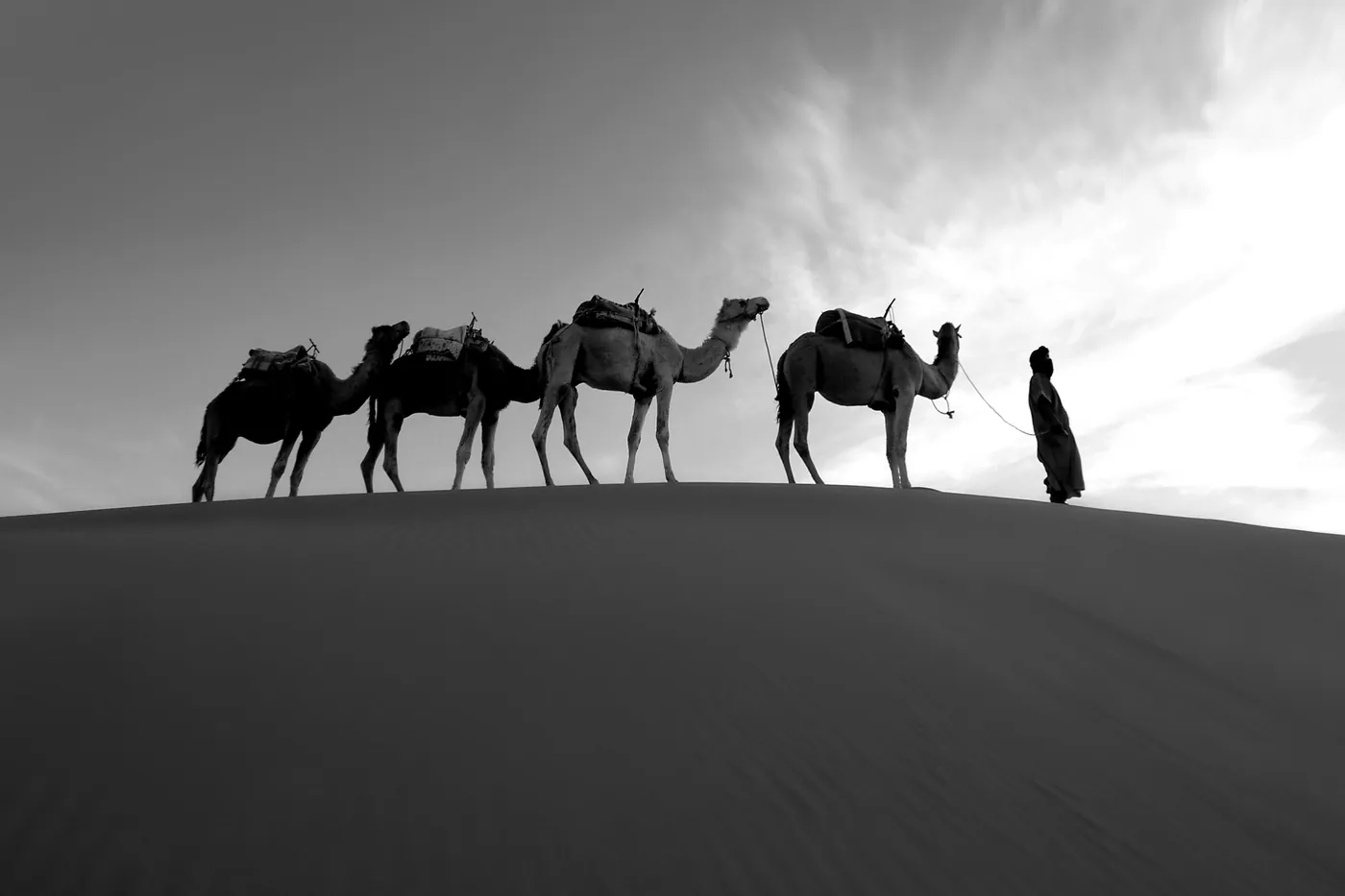
Photography Considerations by Season
If capturing the trek and camp on camera matters to you, season affects more than just comfort. Winter’s clearer, drier air tends to produce sharper long-distance shots of the dune ridges and a better shot at visible stars or a faint Milky Way band after dark, assuming there’s no moon washing out the sky. Spring and autumn offer warmer-toned golden hour light without the heat haze that can soften images in peak summer, when rising thermal air genuinely blurs distant detail in daytime shots. If a specific photo — sharp stars, crisp dune lines, warm golden light — is the priority driving your trip dates, weight that above general comfort when picking your season.
Camel Trekking Season vs. Other Merzouga Activities
Not every Merzouga activity is as season-sensitive as camel trekking and overnight camping. A 4×4 excursion is shorter and spends most of its time inside an air-conditioned vehicle, making it a reasonable summer alternative if you still want to see the dunes without the sustained heat exposure of a full trek. Visiting Khamlia village for Gnawa music, or a short sunset dune climb from town without an overnight stay, are similarly low-commitment options that work fine even in the hottest months.
If you’re traveling in peak summer and still want a genuine Sahara experience, consider trading the overnight camel trek for one of these shorter, less exposed alternatives — or strictly book your trek and camp for the coolest hours of the day, ideally departing within an hour of sunrise or sunset rather than mid-afternoon.
What to Pack for Your Trek by Season
Whatever season you trek in, layering is the constant theme — the temperature swing between your afternoon departure and the desert-camp night can exceed 20°C regardless of month. For the complete category-by-category packing breakdown, see our full Merzouga packing list and trip-prep guide.

Choosing Your Season: A Quick Decision Guide
If you’re still weighing your options, match your priority to the season that actually serves it rather than defaulting to “spring or fall” by habit:
- Want the most comfortable trek and camp with the least planning: March–May or September–November.
- Chasing the clearest stargazing and sharpest photos: December–February, with warm layers for the desert-camp night.
- Traveling on fixed dates that fall in summer: book strictly for sunrise or sunset, or swap in a shorter 4×4 excursion instead of the full overnight trek.
- Trying to avoid crowds without sacrificing comfort: the edges of the shoulder seasons — early April, late May, early September, or late October.
- Traveling with young children or heat-sensitive travelers: the cooler shoulder months give the widest margin for error if the schedule slips.
Frequently Asked Questions
What is the best season for camel trekking in Merzouga?
March through May and September through November, when daytime highs sit in the mid-20s to low-30s°C and desert-camp nights are cool but manageable.
Can you go camel trekking in summer?
Yes, but treks are scheduled strictly around sunrise and sunset to avoid daytime highs that can reach 43°C (109°F) in July. Midday summer trekking is not advisable.
Is winter a good time for camel trekking?
Daytime trekking is comfortable in winter, though camp nights get genuinely cold, averaging 6°C (43°F) in January. Winter often offers the clearest stargazing of the year in exchange.
When are Merzouga desert camps least crowded?
Shoulder-season months like April, May, September, and October tend to offer good weather with lower occupancy than the peak winter holiday weeks around Christmas and New Year.
Does the season affect how long a camel trek takes?
No — a standard trek runs about an hour each way regardless of season. What changes is comfort, visibility, and stargazing quality, not the trek’s length or difficulty.
What if I’m traveling in summer and still want a desert experience?
Book your camel trek strictly for sunrise or sunset, or swap the overnight trek for a shorter, air-conditioned 4×4 excursion. Both avoid the sustained midday heat exposure that makes a full daytime trek risky in June through August.
What is the best season for camel trekking if I want good photos?
Winter tends to give the clearest stargazing and sharpest distant dune shots thanks to drier air, while spring and autumn offer warmer golden-hour light without the heat haze that can soften summer photos.
Conclusion
There’s no single best season for camel trekking that fits every traveler — it depends on what you’re actually optimizing for. If you’re planning a trip specifically around the camel trek and overnight camp, spring and autumn give you the best combination of comfortable riding conditions and manageable camp nights. Winter rewards you with clearer skies if you can handle the cold, and summer is workable only if you commit to strict sunrise-and-sunset timing. Pick your season based on what matters most to you — comfort, stargazing, or avoiding crowds — rather than defaulting to whichever month happens to fit your calendar.
Ready to plan your trek? Browse our guided Merzouga desert tours or check our full packing list and trip-prep guide before you go.
This is part of our complete guide to the best time to visit Merzouga, covering weather, crowds, and activities month by month.

