English


Merzouga’s daily temperature can swing more than 20°C (36°F) between afternoon and midnight (Weather-and-Climate.com, accessed 2026-08-22). That’s enough to leave an underprepared traveler sunburned by 3pm and shivering by 9pm at the same desert camp. Morocco welcomed a record 19.8 million visitors in 2025 (ATTA / Morocco Ministry of Tourism, Jan 2026). Merzouga’s Erg Chebbi dunes are one of the country’s most-booked side trips from Marrakech. This guide walks through exactly what to pack and how to prepare, so your gear list matches the desert’s actual conditions instead of a generic beach-vacation checklist.
Not sure which season you are packing for? See our guide to the best time to visit Merzouga for month-by-month conditions.
By the end, you’ll have a packing list organized by category, a clear sense of when to go, how to get there, and what documents and money prep to sort out before you leave home.
Key Takeaways
- Merzouga’s daily high can hit 43°C (109°F) in July while dropping to a cool 6°C (43°F) low in January — pack layers, not just summer clothes (Weather-and-Climate.com).
- March, April, October, and November offer the mildest combination of warm days and manageable nights for camel treks and dune camping.
- The Marrakech–Merzouga overland route is roughly 560 km (348 mi); budget a full day for a direct drive or two days for the scenic guided route via the Atlas Mountains.
- Desert hydration guidance runs 3–8 liters of water per person per day depending on heat and activity level — bring a refillable bottle and electrolytes.
- Most Western nationalities (US, UK, EU, Canada, Australia) travel visa-free for tourism, but confirm your specific country’s requirement before booking.
Browse our 3-Day Marrakech to Merzouga Desert Tour to see what’s included on a guided trip.
When to Go: Best Time to Visit Merzouga
The single biggest factor shaping your packing list is timing. Merzouga sits at the edge of the Sahara, where daytime highs and nighttime lows swing dramatically by season.
March, April, October, and November are the sweet spot: daytime highs in the mid-20s to low-30s°C (77–90°F) with nights that are cool but not brutal. June through August push past 39°C (102°F) by day, and the July average low is still a warm 29°C (84°F) — packing for these months is a different exercise entirely (think heat management, not layering). December through February bring the coldest desert nights, with January lows averaging just 6°C (43°F); this is when a proper insulated jacket matters more than sunscreen.
Merzouga’s climate figures come from a 30-year modeled dataset built from hourly weather simulations (meteoblue), which is why the seasonal pattern is consistent year to year even though any single trip can run a few degrees warmer or cooler. In practical terms: check the specific week you’re traveling, but plan your base wardrobe around the month, not the forecast.

Getting to Merzouga From Marrakech
Most travelers reach Merzouga overland from Marrakech, and the route itself shapes what you’ll want accessible in a day bag versus packed away in checked luggage.
The drive covers roughly 560 km (348 mi) over the Tizi n’Tichka pass through the Atlas Mountains — a distance and route consistently reported across multiple Morocco-based tour operators. These are operator-reported route times rather than an independently audited transit-authority figure, so treat the hour ranges below as planning estimates. A direct non-stop drive takes about 9–10 hours; most guided tours split it into two days with an overnight stop in Dades Gorge or Ouarzazate, which is easier on your body and lets you see the Kasbahs along the way. Flying into Errachidia airport and transferring by road cuts total door-to-door time to roughly 5 hours, though flight schedules are limited.
Packing implication: whichever route you choose, keep a day bag with sunscreen, water, snacks, a light layer, and any medication accessible — you won’t want to dig through checked luggage during a mountain-pass rest stop.
For a fuller breakdown of routes from different gateway cities, see our guide on Merzouga transport and access from major Moroccan gateways.
What to Pack: Clothing and Layering
This is where the temperature chart above matters most. Merzouga’s daily swing means a single outfit rarely works for both midday dunes and a desert-camp evening.
Core layering list:
- Lightweight, breathable long-sleeve shirts (better sun protection than short sleeves, and cooler than they look)
- Loose, breathable trousers — avoid tight synthetic fabrics that trap heat
- A warm mid-layer (fleece or light sweater) for evenings, even in summer
- An insulated jacket for winter trips (Nov–Feb), when nighttime lows regularly sit near or below 10°C (50°F)
- A scarf or shesh (the local cotton head wrap) — doubles as sun shade, dust filter during wind, and neck warmth at night
- Closed-toe, sturdy walking shoes for dune access points; sandals are fine at camp but not for the trek itself
- A wide-brimmed sun hat and UV-protective sunglasses
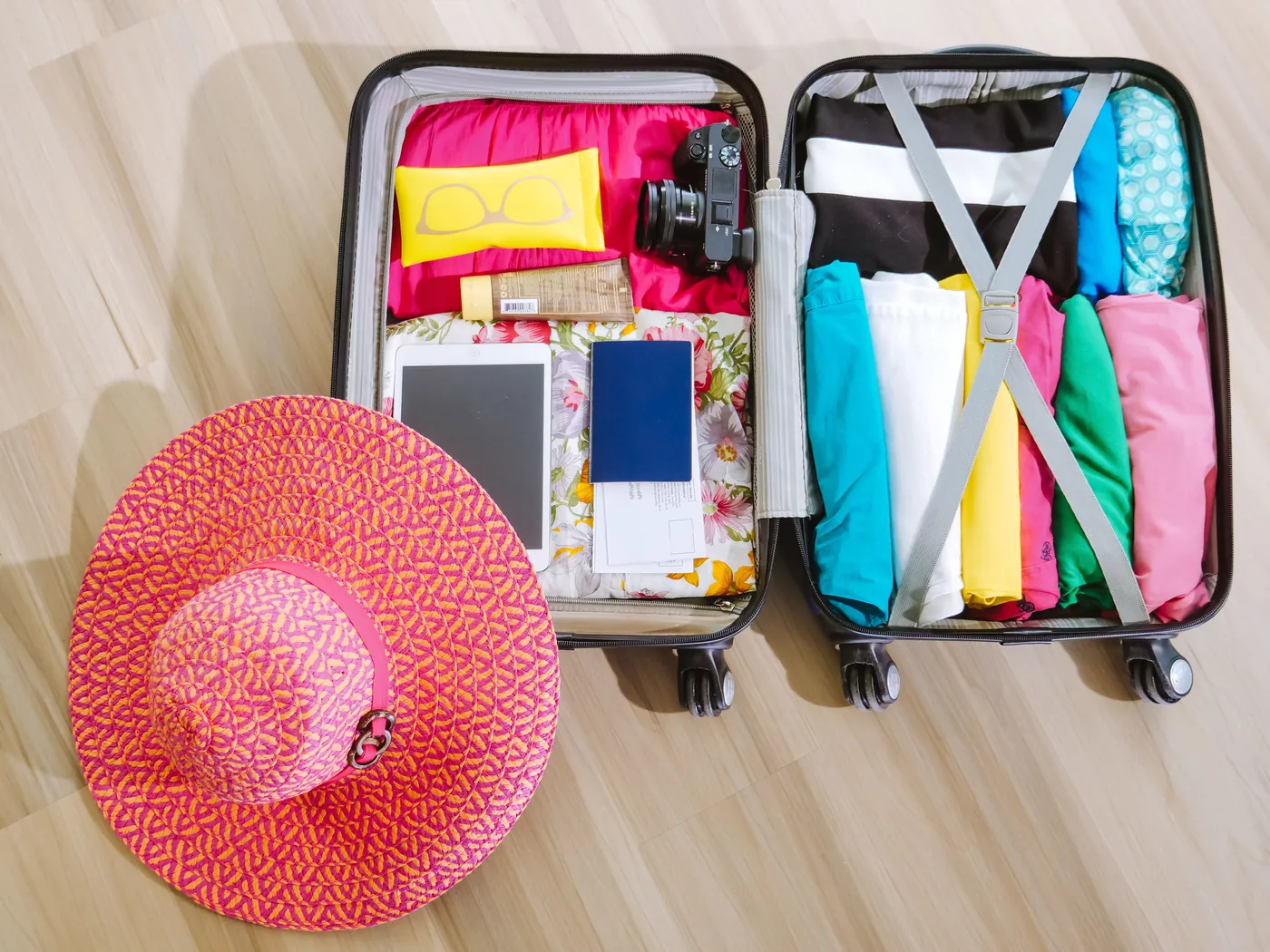
Unique insight: The layering mistake most first-time desert travelers make isn’t forgetting warm clothes — it’s packing warm clothes that are also heavy and bulky. A lightweight fleece and a wind-resistant shell pack down to almost nothing and cover the same temperature range as one bulky sweater, which matters when your bag also has to survive a camel’s back.
Desert Gear and Health Essentials
Beyond clothing, a handful of gear items make the difference between an uncomfortable dune crossing and a manageable one.
- Water bottle (refillable, 1L+) — OSHA/NIOSH heat-illness guidance recommends roughly one cup (8 oz) every 15–20 minutes of heat exposure, which scales to 3+ liters across a full day of dune activity; camps typically supply refill water, but bring purification tablets as backup for remote stops
- High-SPF sunscreen and lip balm with SPF — reapply more often than you would at the beach; there’s no shade on open dunes
- Electrolyte tablets or powder — supplements plain water when you’re sweating heavily in daytime heat
- A basic first-aid kit — blister care, rehydration salts, any personal medication in original packaging
- A headlamp or small flashlight — desert camps often run on generator power only part of the night
- Dust-proof bags or ziplock bags — protect phones, cameras, and electronics from fine Sahara sand, which gets into everything
- A portable power bank — outlets are limited or nonexistent at most desert camps

OSHA and NIOSH’s occupational heat-illness guidance (OSHA-NIOSH Heat Illness Infosheet) — built for people working outdoors in extreme heat, a reasonable proxy for a full day of dune trekking — calls for drinking before you feel thirsty and pacing intake in small, frequent amounts rather than large infrequent gulps. In practical terms, plan closer to 3+ liters on a camel-trekking or 4×4 day, sip steadily rather than waiting until you’re thirsty, and bring a bottle you’ll actually refill rather than relying on single-use plastic.
Documents, Money, and Visa Prep
Sort this before you fly — it’s the packing category that’s hardest to fix once you’re already in the desert.
- Passport with 6+ months validity and a photocopy (physical or photo) stored separately from the original
- Visa check: most Western nationalities — including the US, UK, EU countries, Canada, and Australia — travel to Morocco visa-free for short tourist stays under its published visa-exemption policy (Visa policy of Morocco, Wikipedia). Requirements vary by nationality and can change, so confirm with your nearest Moroccan consulate or your home country’s official travel-advisory site before booking
- Travel insurance covering activities like camel trekking and desert excursions specifically — check the policy fine print
- Cash in Moroccan Dirham (MAD) — many desert camps and small vendors near Merzouga are cash-only; ATMs are common in Marrakech but sparse once you’re past Ouarzazate
- A copy of your current travel advisory status for Morocco from your home country’s government site, checked close to departure
Daily budget ranges cited across multiple 2026 Morocco travel-cost guides cluster around $30–60/day for backpacker travel, $80–150/day for mid-range, and $200–400+/day for luxury. These figures reflect travel-industry consensus rather than a single authoritative economic source, so treat them as planning guidance and check current exchange rates before you go. For context on how fast pricing can shift: Morocco’s tourism receipts reached roughly MAD 124 billion (~$13.5B) in the first 11 months of 2025 alone (Morocco Ministry of Tourism data, via Ecofin Agency, Jan 2026).
| Travel style | Approx. daily cost (USD) | Typical trade-offs |
|---|---|---|
| Budget / backpacker | $30–60 | Shared or basic-tent camps, public transport or shared grand taxis, street food |
| Mid-range | $80–150 | Private guided tours, comfortable desert camps, mix of restaurants |
| Luxury | $200–400+ | Private 4×4 transfers, glamping-style camps with en-suite bathrooms, full-board dining |
Table: same source as above; planning estimates, not fixed pricing.
Desert Camp and Camel Trek: What to Expect
Once you reach Erg Chebbi, most itineraries include a camel trek out to a desert camp for sunset, dinner, and an overnight stay before a sunrise ride back.

A few practical notes that affect what you pack for this leg specifically:
- Camel treks typically run 45–90 minutes each way — comfortable, closed-toe shoes matter more than style here; sand gets into open sandals within minutes.
- Desert camps range from basic Berber tents to glamping-style setups with real beds and en-suite bathrooms — check what your specific camp includes before assuming amenities.
- Nights are genuinely dark and often clear, making stargazing a highlight — but also meaning temperatures drop fast after sunset, even in warmer months. Keep a layer within reach, not buried in your main bag.
- Generators typically run only part of the night, so don’t count on charging devices freely; a power bank is the more reliable option.
Watch: Merzouga, Morocco: Incredible 3-Day Sahara Desert Tour — Tips for an Unforgettable Journey (Finding Gina Marie – Travel the World) walks through what a multi-day Merzouga desert trip actually looks like, camp to camel trek.
Common Packing Mistakes to Avoid
- Packing only summer clothes because “it’s the desert.” The instinct is to pack like you’re headed to the beach, but the same 24-hour period in Merzouga can span a 20°C+ swing. The fix: pack for the coldest hour of your trip, not the hottest.
- Bringing a hard-shell suitcase instead of a duffel or soft bag. Camel transport and 4×4 loading favor bags that flex and strap down easily. A rigid suitcase is awkward to secure and more likely to get damaged. The fix: use a soft duffel or backpack for the desert-camp leg, even if your main luggage is a hard case left at your riad.
- Underestimating water needs. Travelers used to temperate climates often bring one small bottle and assume camp water covers the rest. The fix: carry your own refillable bottle and treat 3+ liters per day as a baseline, more on trekking days.
- Skipping the visa/consulate check because “Morocco is visa-free.” Visa-free status varies by nationality, and travel-advisory levels change. The fix: verify your specific country’s requirement and check your government’s current travel advisory shortly before departure, not months in advance.
- Leaving electronics unprotected from sand. Fine Sahara sand works into zippers, ports, and camera lenses faster than most travelers expect. The fix: pack phones and cameras in a dust-proof pouch or ziplock bag whenever you’re not actively using them.
What a Well-Packed Trip Looks Like
If you’ve worked through the categories above, you should have: a layered clothing system that covers both midday heat and desert-camp cold, sun and hydration gear suited to actual desert conditions rather than a beach trip, your documents and visa status confirmed, and a bag format that survives camel and 4×4 transport.
The one upgrade worth considering beyond this list: a compact daypack separate from your main luggage, so the items you need during the drive and camel trek (water, sunscreen, layer, camera) never get buried under everything else.
Browse our Merzouga desert camp packages to book your trip.
Frequently Asked Questions
Do I need a visa to visit Merzouga, Morocco?
Most travelers from the US, UK, EU, Canada, and Australia can enter Morocco visa-free for short tourist stays, but exact requirements vary by nationality and can change. Confirm with your nearest Moroccan consulate or an official visa portal before booking travel.
How cold does it get in the Sahara at night near Merzouga?
It depends heavily on season. Winter nights (December–February) can drop close to or below 10°C (50°F), with January averaging a 6°C (43°F) low. Even in summer, nights are noticeably cooler than the scorching daytime highs, so pack a warm layer regardless of when you travel.
Is Erg Chebbi the same as Merzouga?
Erg Chebbi is the specific sand dune formation — roughly 28 km long and rising up to 150 meters — located just outside the town of Merzouga, which serves as the gateway and base for desert camps and tours.
Can I do a Merzouga desert trip as a day trip from Marrakech?
It’s technically possible by flying into Errachidia and transferring by road, cutting total travel time to roughly 5 hours each way, but most travelers find an overnight desert-camp stay is the point of the trip. A rushed day trip skips the camel trek and stargazing that make Merzouga worth visiting.
How much cash should I bring for a Merzouga trip?
Bring enough Moroccan Dirham to cover several days, since ATMs become sparse past Ouarzazate and many desert camps and small vendors are cash-only. Budget travelers report daily costs around $30–60, mid-range around $80–150, though these are planning estimates — check current exchange rates before departure.
Conclusion
Packing for Merzouga comes down to one core principle: prepare for the temperature swing, not just the destination’s reputation as “the desert.” A layered wardrobe, solid hydration and sun gear, confirmed documents, and a bag format suited to camel and 4×4 transport will cover nearly every scenario the Sahara throws at you. Sort your visa status and travel insurance early, and leave the rest to the flexible layering system above.
Ready to put this list into action? Browse our guided Merzouga desert tours or read our Merzouga transport and access guide to plan the journey itself.