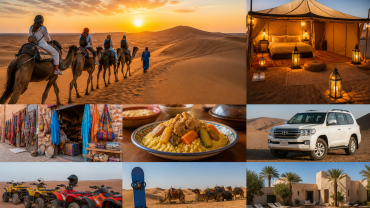
English


Merzouga has a reputation as a splurge destination — private tours, luxury desert camps, all-inclusive multi-day loops. It doesn’t have to be. With public buses instead of private transfers, shared desert camps instead of premium ones, and market food instead of hotel restaurants, a trip to the Erg Chebbi dunes is genuinely reachable on a backpacker budget.
This guide breaks down exactly what that costs in 2026, route by route and category by category, and lays out a realistic 4-day itinerary built around those numbers.
Written by the Merzouga Explorer team, specializing in Sahara desert trips out of Merzouga. About Merzouga Explorer · Get in touch
Key Takeaways
– A realistic backpacker daily budget in Morocco runs $30-45/day (300-450 MAD), covering dorm beds, local buses, and street food.
– The Marrakech-to-Merzouga-area bus costs ~140 MAD (~$14) on CTM or ~200 MAD (~$20) on Supratours — a fraction of a private transfer.
– A standard shared desert camp (camel trek, dinner, breakfast included) runs roughly $40-80 per person, well below premium camp pricing.
– A 4-day budget trip covering transport, a shared camp night, hostel nights, and food comes in well under $200 total, excluding any multi-day guided tour.
How Much Does a Backpacker Trip to Merzouga Actually Cost?
A realistic daily budget for backpacking Morocco in 2026 sits at roughly $30-45 a day. That covers dorm beds, buses, and local food. Two independent estimates converge on close to this same range: an aggregated Morocco travel-cost breakdown puts it at 300-450 MAD (tililatravel.com, retrieved 2026-08-29), and long-running budget-travel publisher The Broke Backpacker separately estimates comfortable backpacker spending at roughly $35-55/day (The Broke Backpacker: Backpacking Morocco, retrieved 2026-08-29). This figure holds reasonably well for Merzouga itself. If anything, it skews a little cheaper than Marrakech or Chefchaouen. Smaller towns outside the main tourist circuit tend to run 15-25% below the national average.
For everyday costs, Numbeo’s 2026 country data for Morocco puts a meal at an inexpensive restaurant around $4, and a one-way local transport ticket around $0.54 (Numbeo Cost of Living: Morocco, retrieved 2026-08-29). Neither of those numbers is Merzouga-specific — Numbeo aggregates nationally — but they’re a useful floor for what “cheap” actually looks like on the ground.
If you want the non-budget-specific version of these numbers, see our full Merzouga trip-cost breakdown.
Getting to Merzouga on a Budget
This is where backpacking Merzouga saves the most money compared to a private tour. Two intercity coach operators run this route:
- CTM, Morocco’s state-linked national coach line, at roughly 140 MAD (about $14) for the Marrakech-to-Merzouga-area route.
- Supratours, Royal Air Maroc’s coach subsidiary, running slightly higher at roughly 200 MAD (about $20) for the same corridor, reflecting a somewhat more comfortable service tier (citytoursmorocco.com: CTM vs. Supratours, retrieved 2026-08-29).
| Operator | One-way fare | Approx. duration | Comfort tier |
|---|---|---|---|
| CTM | ~140 MAD (~$14) | ~10-12 hours | Standard |
| Supratours | ~200 MAD (~$20) | ~10-12 hours | Slightly higher comfort tier |
Fares on both lines fluctuate with season and route changes, so treat these as planning estimates and confirm the current fare directly at ctm.ma or supratours.ma before booking — third-party aggregator pricing pages are frequently out of date.
Once you’re in the area, a shared grand taxi between nearby towns (for example, Merzouga to Rissani) typically runs $5-9 for the roughly 37-minute hop (rome2rio.com, retrieved 2026-08-29) — useful for the last-mile stretch buses don’t cover directly.
For travelers who’d rather self-drive than bus it, budget car rental in Merzouga itself starts from around $35-45/day — not “backpacker” pricing exactly, but worth knowing as a comparison point if you’re splitting the cost three or four ways. See current rental rates for what’s available right now.
For a full breakdown of every route into town, see full route comparison. Flying in instead? See airport arrival guide.
Where to Sleep Without Blowing the Budget
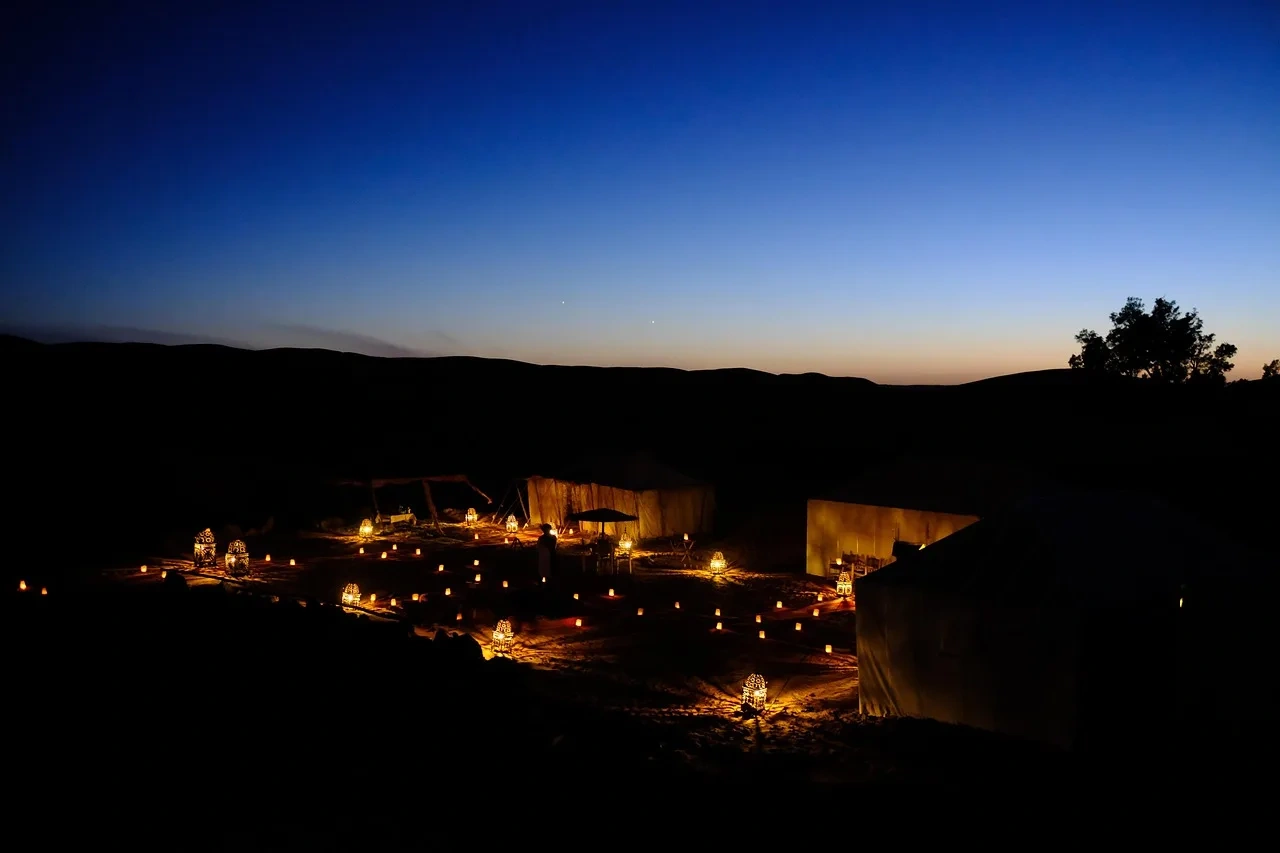
You have two budget-friendly sleeping options in and around Merzouga, and they serve different parts of a trip:
In town, hostel and budget guesthouse prices range from roughly $8-35/night, with the very cheapest listings dipping under $20 and mid-budget guesthouses (private room, wifi, sometimes a pool) landing closer to $50 (Hostelworld, Kayak, retrieved 2026-08-29). Prices shift by season and even by day of the week, so booking a few days out rather than same-day tends to get better rates.
In the dunes, a standard shared desert camp — traditional tent, shared bathroom facilities, a camel trek plus dinner and breakfast included — typically runs $40-80 per person per night, well under premium or “luxury” camp pricing that can run several times that (desert camp pricing summaries, retrieved 2026-08-29). Group size and season both move that number meaningfully, so a shared/group booking rather than a private one is the single biggest lever if the camp night is your main splurge.
For a closer look at every price tier in between, see comparing camp tiers.
Eating Well for Not Much
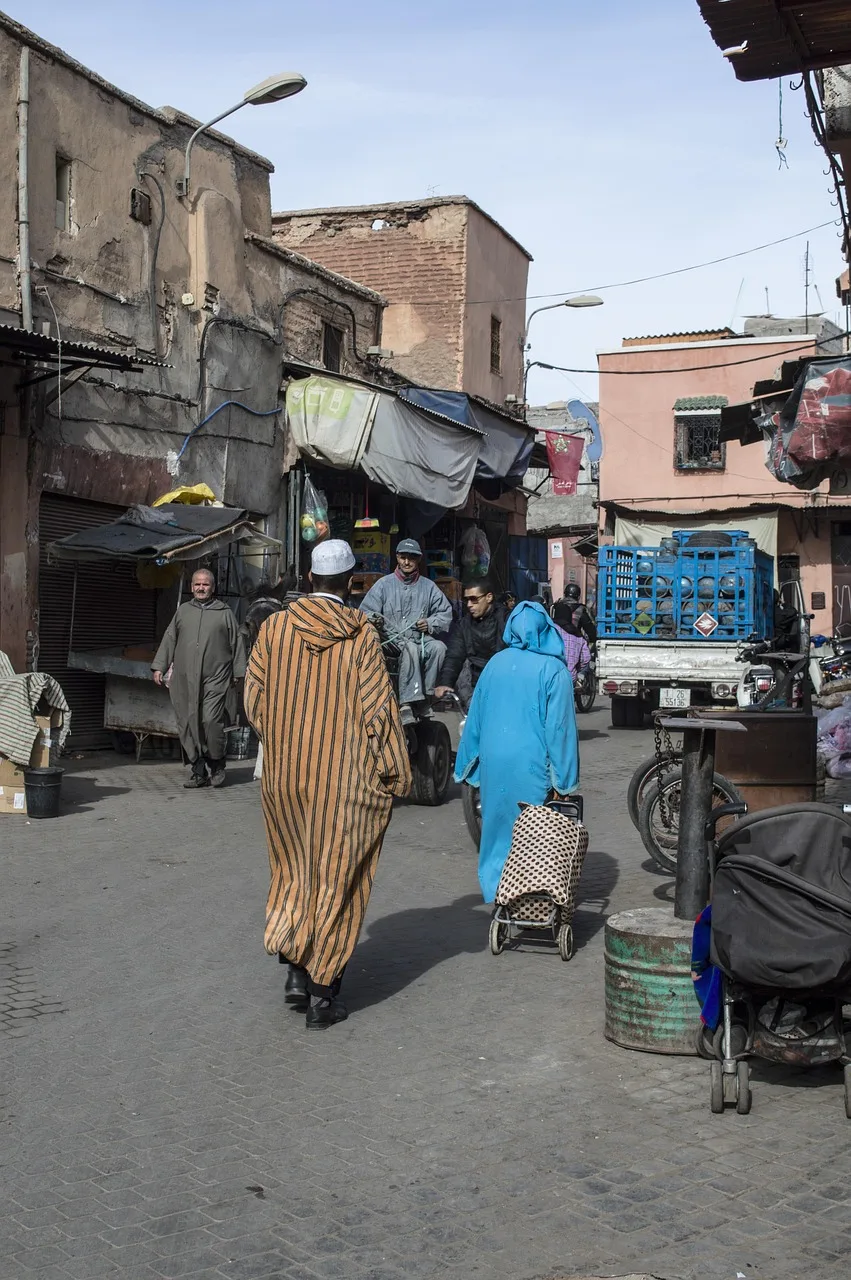
Food is where a backpacker budget in Morocco stretches furthest. A meal at an inexpensive restaurant runs around $4, and market stalls and street food push that even lower (Numbeo, retrieved 2026-08-29). A day of market-and-cafe eating — bread, tagine, mint tea, fresh fruit from a stall — realistically lands somewhere in the $8-15 range for most travelers, and that’s before you even look for the cheapest option in town.
Sit-down restaurants aimed at tourists cost more — a mid-range three-course meal for two runs around $27 (Numbeo, retrieved 2026-08-29) — so the biggest single food-budget decision is simply how often you eat where other travelers eat versus where locals eat.
A 4-Day Budget Merzouga Itinerary
Here’s how those numbers assemble into an actual trip, assuming you’re arriving from Marrakech and traveling solo or splitting camp costs with others you meet en route:
- Day 1 — Marrakech to Merzouga. Take the CTM or Supratours coach (~$14-20). It’s a long day on the road, so bring food and water rather than relying on stops. Arrive in the evening and check into a budget guesthouse in town.
- Day 2 — Erg Chebbi and a shared desert camp. Spend the day in Merzouga, then join a shared (not private) overnight camel trek and camp package for the evening — camel trek, dinner, and breakfast typically bundled for $40-80 per person. This is the one night worth budgeting a bit more for; it’s the actual reason you came.
- Day 3 — Back to town, activities on your own terms. Return from the dunes by camel or 4×4 in the morning. Spend the day on low-cost or free activities — walking the town, watching the light change over the dunes at sunset, or booking a single add-on activity (a short camel trek or sandboarding session) rather than a bundled multi-activity package.
- Day 4 — Departure. Bus back out via CTM or Supratours, or continue on to your next stop if you’re routing through Errachidia or onward through the desert circuit.
Before you go, check packing for this exact trip.
Rough total for this 4-day stretch (excluding a multi-day guided tour, which is a different trip style entirely): bus in + bus out (~$28-40), 2 budget guesthouse nights (~$20-40), one shared camp night (~$40-80), and food for 4 days (~$32-60) — landing somewhere around $120-220 depending on choices, well before any single-tour splurge.
How Much Should You Really Budget?
It’s worth seeing where backpacker spending sits relative to other travel styles, since “budget” only means something in contrast. A broader two-week Morocco trip, factoring in guided tours and better accommodation, runs roughly $700-2,000 per person excluding flights — about $50-140 a day (citytoursmorocco.com, retrieved 2026-08-29). Backpacker spending at $30-45/day sits well under even the low end of that range, which is the whole point: the same Erg Chebbi dunes, the same camel trek, the same sunset, at a fraction of the cost — you’re mainly trading private comfort for shared logistics.
Frequently Asked Questions
Is Merzouga actually affordable for backpackers, or is it a splurge-only destination?
It’s genuinely reachable on a budget. The bulk of “expensive Merzouga” pricing comes from private multi-day tours and premium desert camps — public buses, shared camps, and market food bring the same core experience (the dunes, a camel trek, a night under the stars) down to $30-45/day.
Can I skip the desert camp entirely and still see the dunes?
Yes — a day trip to Erg Chebbi from town, or a short sunset camel ride without an overnight stay, cuts the single biggest line-item in this budget. You’ll miss the stargazing and sunrise, which is the main tradeoff.
Is it safer or cheaper to book a shared camp on arrival versus in advance?
Booking a few days ahead generally gets better rates than same-day arrangements, and gives you time to compare shared-group options rather than accepting the first offer you’re given in town.
How does this compare to booking a multi-day guided tour instead?
A bundled multi-day tour (transport, all camps, all meals, a private guide) costs considerably more than assembling the trip yourself with public buses and a shared camp, but it also removes the planning and timing risk — there’s a real tradeoff, not a strictly better option.
The Bottom Line
Merzouga’s dunes don’t cost what a glossy multi-day tour brochure suggests. Bus fares, shared camps, and market food get you the same sunset, the same camel trek, and the same night under the Sahara sky for $30-45 a day rather than several times that. The itinerary above is a starting point, not a fixed script — adjust the balance of comfort and cost to match your own trip.
Ready to add a specific tour or activity to this trip? browse tours and activities.
This guide is maintained by the Merzouga Explorer team and updated as prices, routes, and seasonal conditions change. Last updated 2026-08-29.