English


Every trip-planning thread about Morocco eventually asks the same question: should you drive to Merzouga for the “real” Sahara, or is the Agafay desert near Marrakech close enough to call it done? Both are sold as “desert experiences,” both show up in the same search results, and both photograph beautifully — which is exactly why the choice gets confusing.
The honest answer is that they aren’t really competing for the same trip. One is a half-day add-on you can book from your riad. The other is a multi-day journey across the High Atlas that ends at 150-meter sand dunes on the edge of the actual Sahara. This guide lines up the two side by side — distance, price, and what you’ll actually be looking at when you get there — so you can pick based on your calendar and your expectations, not just a search result.
Key Takeaways
• Agafay is roughly 30–35 km from Marrakech (about a 45-minute drive), making it a viable half-day or overnight trip (Aziz Agafay Desert, retrieved 2026-08-28).
• Merzouga sits about 560 km from Marrakech, a 9–10 hour drive best split across 2–3 days (MerzougaWay Tours, retrieved 2026-08-28).
• Agafay is a rocky hamada plateau with no real sand dunes; Merzouga’s Erg Chebbi has genuine Saharan dunes up to about 150 meters high (Erg Chebbi, Wikipedia, retrieved 2026-08-28).
• Agafay day-trip activities run roughly €29–€149 per person; a shared 2-night, 3-day Merzouga tour starts around €95–€300+ per person for the whole trip.
• If you have one free afternoon, go to Agafay. If you have three days or more and want the dunes you’ve actually seen in photos of Morocco, go to Merzouga.
How Far Is Each Desert From Marrakech?
Distance is the single biggest reason people cross Agafay off the list or rule out Merzouga — and it’s worth being precise about, because the gap is much bigger than it sounds on a map.
Agafay sits about 30–35 km southwest of Marrakech, roughly 45 minutes by road, on a rocky plateau at around 650 meters elevation (Aziz Agafay Desert, retrieved 2026-08-28). You can leave your hotel after breakfast and be back for dinner.
Merzouga is a different order of trip. It’s about 560 km from Marrakech, and the drive itself takes 9–10 hours of actual driving time — closer to 10–13 hours once you factor in stops. The route runs over the Tizi n’Tichka pass (2,260 m) through the High Atlas, then via Ouarzazate and the Dades Valley before reaching Erg Chebbi (MerzougaWay Tours, retrieved 2026-08-28). Almost no one drives this in a single push; it’s built as a 2–3 day journey with stops at Aït Benhaddou, Ouarzazate, and the Dades or Todra gorges along the way. For the full breakdown of routes and stops, see our guide to getting to Merzouga.
Real Sahara Dunes vs. a Rocky Plateau: What Are You Actually Looking At?
This is the part travelers underestimate most, and it’s the one that should decide the trip more than distance or price.
Agafay is a hamada — a stony, semi-arid plateau of dried riverbeds, scrubby hills, and rock, set against a backdrop of the Atlas Mountains. It’s genuinely striking in its own right, often described as “lunar” or “Martian,” and it photographs beautifully at sunset. What it doesn’t have is sand dunes. There’s no climbing a dune ridge at Agafay, because there isn’t one.
Merzouga is the real thing: Erg Chebbi, a sea of wind-formed dunes running about 28 km north to south along the Algerian border, with peaks reaching roughly 150 meters above the surrounding hamada (Erg Chebbi, Wikipedia, retrieved 2026-08-28). This is the landscape in the postcard shots of Morocco — the rolling gold ridgelines, the shadow lines at sunrise, the silence once the day-trippers leave. We run camel treks into these dunes most evenings of the year, and the moment guests consistently react to isn’t the ride itself — it’s cresting the first high dune and realizing the sand genuinely doesn’t stop at the horizon. See our full Erg Chebbi dune guide for more.
In practical terms: if “standing on a real Saharan sand dune” is on your list, Agafay cannot deliver it, no matter how the tour is marketed. If you mainly want a desert-adjacent evening near Marrakech — camp atmosphere, mountain backdrop, a fire pit and a show — Agafay does that well and does it close to home.
What Does Each Trip Actually Cost?
Because Agafay is a single day and Merzouga is a multi-day trip, comparing their prices only makes sense once you separate “cost per activity” from “cost per trip.”
Agafay, priced by activity for 2026, typically runs:
| Activity | Price per person |
|---|---|
| Sunset camel ride | ~€29 |
| Quad biking (1 hour) | ~€40 |
| Quad + sunset camel combo | ~€59 |
| Quad + Berber dinner show | ~€59 |
| Buggy adventure (1.5 hrs, per buggy for 2) | ~€149 |
| Full-day pool/VIP day | ~€119 |
(Source: Aziz Agafay Desert, 2026 pricing, retrieved 2026-08-28.)
Merzouga, priced by trip, generally breaks down as (figures below are quoted in USD by the source; treat them as roughly on par with the euro figures above for comparison purposes):
- Budget shared tours: roughly $80–$120 per person, per day
- Mid-range tours: roughly $120–$250 per person, per day
- Luxury tours (private 4×4, deluxe or ensuite camp): $300+ per person, per day
A typical shared 3-day, 2-night Marrakech-to-Merzouga tour — minibus transport, half-board, sunset and sunrise camel treks, and a comfortable camp with real beds — starts around €95 per person, with deluxe or ensuite camp upgrades adding roughly €40–€65 (Morocco Desert Guide; Marrakech Desert Trips, retrieved 2026-08-28). See our own Merzouga desert tour pricing guide for a full breakdown by camp level and group size.
Per day, the two aren’t far apart — but Agafay’s number covers a few hours, and Merzouga’s covers transport, two nights of accommodation, all meals, a guide-driver, and two camel treks. Judged strictly by euros spent per hour of desert, Merzouga is the better value; judged by total euros out of pocket for the trip, Agafay is cheaper because it’s simply shorter.
What’s the Experience Actually Like on the Ground?
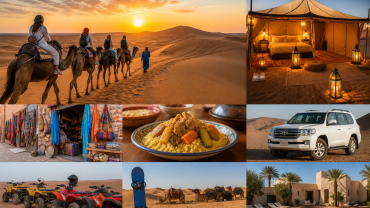
A day at Agafay usually means hotel pickup, a short drive, and a menu of activities: camel ride, quad biking, sometimes a buggy, followed by a Berber-style dinner with music around a fire as the sun drops behind the Atlas. Overnight glamping camps have made it possible to stretch this into two days, with pool access and comfortable tents. It’s well-organized, low-commitment, and works even if you land in Marrakech with only a day or two to spare.
A multi-day Merzouga trip is a different kind of experience because the journey is part of it. Day one crosses the Tizi n’Tichka pass and stops at Aït Benhaddou, a UNESCO-listed kasbah used in countless films, before continuing through Ouarzazate and the Dades or Todra gorges. Day two ends with a sunset camel trek into Erg Chebbi and a night at a desert camp under skies with minimal light pollution — genuinely dark enough to see the Milky Way on a clear night. Day three brings a sunrise camel ride back out of the dunes before the drive returns via the Draa Valley’s palm groves. If you’re booking a multi-day trip, our Sahara packing list covers what to bring.
The detail most first-time visitors don’t expect is how much of the value sits in the drive itself, not just the destination. Aït Benhaddou, the Dades Valley, and the Todra Gorge are significant stops in their own right — travelers who fly in specifically for “the desert” often leave saying the two days getting there were as memorable as the dunes.
Both deserts deliver genuinely good stargazing and a real change of pace from Marrakech’s medina. The difference is scale: Agafay gives you a taste in an afternoon; Merzouga gives you the immersive version, at the cost of several driving days.
Which One Should You Choose?
Run through these questions honestly before booking:
- How many days do you actually have? Under 2 days in the Marrakech area: Agafay. 3+ days available: Merzouga is realistic and worth prioritizing.
- Do you specifically want to see sand dunes? If the goal is standing on a real dune ridge, only Merzouga delivers that — Agafay’s terrain is rock and gravel, not sand.
- Are you traveling with young kids or limited mobility? Agafay’s short drive and flexible activity list make it the easier logistical choice; Merzouga’s long travel days suit travelers comfortable with extended road time.
- Is this a one-time Morocco trip or a return visit? If it’s a first and possibly only visit, most travelers regret skipping Merzouga more than they regret the extra driving.
- What’s your budget for time, not just money? Agafay optimizes for convenience; Merzouga optimizes for the complete Sahara experience.
Can You Do Both?
Yes, and if your schedule allows it, this is often the smartest itinerary rather than a compromise. Book Agafay for an evening near the start or end of your trip — it pairs naturally with a day exploring Marrakech and needs no extra planning. Then commit separate days specifically to the Merzouga route, treating it as its own mini-expedition rather than a rushed add-on. Trying to squeeze both into the same short window usually shortchanges Merzouga, which is the one that needs the time. Start planning at our Merzouga destination hub.
Frequently Asked Questions
Is Agafay considered part of the Sahara?
No. Agafay is a rocky hamada plateau near Marrakech; the Sahara proper, including the sand dunes most people picture, starts much further southeast around Erg Chebbi near Merzouga.
Can I visit Merzouga as a day trip from Marrakech?
Not realistically. The drive alone is 9–10 hours each way, so a same-day round trip would mean roughly 18–20 hours of driving for only a few hours at the dunes. Merzouga is planned as a 2–3 day trip at minimum.
Which is better for families with young children?
Agafay, generally. The shorter drive and flexible half-day format are easier on young kids than multiple long travel days, though families with more time and older children often find the Merzouga trip equally manageable and more memorable.
Does Agafay have real sand dunes like Merzouga?
No. Agafay’s landscape is rocky and semi-arid; the tall golden sand dunes associated with Morocco are specific to ergs like Erg Chebbi at Merzouga (and Erg Chigaga further south near Zagora).
Is Merzouga worth the long drive?
For most travelers who make it, yes — the combination of Aït Benhaddou, the Atlas crossing, the gorges en route, and the dunes themselves is consistently rated as a trip highlight rather than a chore, provided it’s booked as a multi-day trip rather than rushed.
The Bottom Line
Agafay and Merzouga aren’t really rivals — they’re different trips for different amounts of time. Agafay is the easy, closer option that fills an afternoon or evening well. Merzouga is the trip that gets you to an actual Saharan erg, with real dunes, a genuinely dark sky, and a journey through the Atlas that’s worth the extra days on its own merits.
If your calendar allows for it, Merzouga is the one to prioritize — it’s the desert experience Morocco is known for, and it’s not one you can shortcut. Browse our Merzouga desert tours for current departure dates and camp options, or get in touch and we’ll help you build an itinerary that fits the time you actually have.
Related reading: Merzouga vs. Zagora: Which Sahara Desert Gateway Should You Choose?