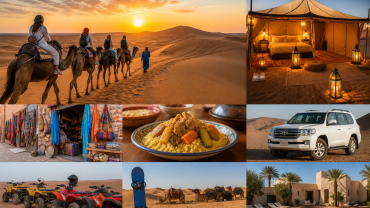
English


The best way to travel to Merzouga depends on where you’re starting from, how much time you have, your budget, and how much comfort or flexibility you want along the way. For most international travelers, that means either a private transfer or rental car from Marrakech or Fes (roughly 7–11 hours of driving, often split over two days), a flight to Errachidia followed by a short transfer if you’re short on time, or a multi-day organized tour that turns the journey itself into part of the trip. Budget travelers can reach Merzouga by long-distance bus plus a local transfer, though it takes considerably longer. There’s no single “best” option — only the best option for your specific trip, which the sections below will help you identify.
Before you lock in a route, it is worth reading our honest breakdown of whether Merzouga is worth visiting in the first place.
Quick Comparison: Ways to Travel to Merzouga
Before the full breakdown, here’s how the main options stack up against each other. Times below vary by starting city — see the route sections further down for specifics.
| Option | Best For | Approx. Time | Cost Level | Flexibility | Main Advantage |
|---|---|---|---|---|---|
| Fly to Errachidia + Transfer | Time-limited travelers, longer starting distances (e.g. Casablanca) | ~1 hour flight + 1.5–2 hour transfer | $$$ | Low (fixed flight days) | Skips the long overland drive entirely |
| Private Transfer | Comfort, families, no interest in driving | Matches driving time for your route | $$$ | Medium–High (custom pickup, stops on request) | Door-to-door comfort, no navigation stress |
| Rental Car | Independent travelers, road-trippers | Matches driving time for your route | $$ | Highest | Full control over pace, stops and schedule |
| Organized Tour | First-time visitors, solo travelers, sightseeing | Usually 2–4 days total | $$–$$$ | Low–Medium (fixed itinerary) | Logistics and sightseeing handled together |
| Bus | Budget travelers with flexible schedules | Longest overall, plus a local transfer at the end | $ | Low (fixed schedule and stops) | Cheapest way to cover the distance |
Where Is Merzouga?
Merzouga is a village in southeastern Morocco, in the Drâa-Tafilalt region, right at the edge of the Erg Chebbi dunes and close to the Algerian border. It sits well beyond Morocco’s main coastal cities and the Middle and High Atlas mountains, which is exactly why reaching it is a genuine journey rather than a short hop — there’s no major highway running directly to it, and no international airport nearby. The closest sizeable town is Rissani, with Erfoud a little further north; the nearest regional airport, Errachidia, is roughly two hours away by road. For general orientation on the destination itself, see our Merzouga travel guide.
What Is the Best Way to Get to Merzouga?
There isn’t one universally “best” way — the right choice depends on four things: where you’re starting from, how many days you have, your budget, and whether you want the journey itself to be part of the experience or purely a means to an end. A traveler flying into Marrakech with ten days to spend will make a different choice than someone flying into Casablanca for a five-day trip, or a backpacker prioritizing cost over comfort.
As a general rule: if you’re short on time, flying to Errachidia and transferring in is the fastest realistic option. If you want flexibility and don’t mind driving, a rental car gives you the most control. If you’d rather not drive unfamiliar mountain roads yourself, a private transfer or organized tour covers the same ground with someone else handling the logistics. If budget matters more than time, a long-distance bus followed by a local transfer is the cheapest route in. The detailed sections below explain why, route by route.
What Is the Nearest Airport to Merzouga?
Errachidia Airport (ERH) — officially Errachidia Moulay Ali Cherif Airport, per Morocco’s national airports authority (ONDA) — is the closest airport to Merzouga, roughly 120–130 km away by road — about 1.5 to 2 hours by car. However, it’s a small regional airport with limited flight connections, mainly domestic routes to Casablanca operated by Royal Air Maroc, and frequency can be low (sometimes just a few flights a week). Because of this, many travelers actually find it more practical to fly into Marrakech, Fes or Ouarzazate — airports with far more international connections — and then continue overland or by transfer, even though those airports sit further from Merzouga in kilometres.
In short: Errachidia is nearest by distance, but Marrakech is usually the more practical gateway for international travelers, and Ouarzazate is a useful middle ground if you’re already touring central Morocco. Flight schedules for regional Moroccan airports change often, so always check current availability directly with the airline or a booking platform before planning around a specific flight.
Errachidia Airport to Merzouga
From Errachidia Airport, Merzouga is approximately 120–130 km away, generally taking around 1.5 to 2 hours by road depending on the exact route and any stops. You have three realistic ways to cover this last leg:
- Pre-booked private transfer — arranged in advance, meets you at arrivals, door-to-door to your hotel or desert camp meeting point. This is the option most travelers use, since taxi availability at this small airport can be inconsistent.
- Rental car — car rental options directly at Errachidia Airport are limited compared to Marrakech or Fes, so it’s worth confirming availability before you fly rather than assuming a counter will be open.
- Taxi — available but best arranged or at least price-confirmed on arrival rather than assumed; fares aren’t metered the way they are in larger cities.
Advantages: By far the shortest final-leg distance of any airport option, and a realistic way to reach Merzouga in a single afternoon. Disadvantages: Limited, infrequent flights (mostly via Casablanca), fewer car rental counters, and less taxi infrastructure than a major airport. For the full breakdown of transfer options, pricing considerations and booking logistics, see our dedicated Errachidia Airport to Merzouga distance and transfer guide and private transfer guide. If you’re arriving with limited cash or an inactive SIM card, our Errachidia arrival guide covers those first steps.
Marrakech to Merzouga

Marrakech is the most common starting point for travelers heading to Merzouga, mainly because it’s Morocco’s best-connected international airport. The route covers roughly 560 km and typically takes 9 to 11 hours of actual driving, following: Marrakech → the High Atlas via the Tizi n’Tichka pass → Aït Ben Haddou / Ouarzazate → the Dades or Todra Gorge region → Erfoud/Rissani → Merzouga.
Because of the distance and the mountain driving involved, this route is best treated as a journey in its own right rather than a same-day transfer. Most travelers — whether self-driving, on a private transfer, or on an organized tour — split it across two days, stopping overnight around Ouarzazate or the Dades/Todra Gorges. Doing this means you actually see the Tizi n’Tichka pass, Aït Ben Haddou (a UNESCO World Heritage kasbah) and the gorges in daylight, rather than racing through mountain roads to make it in one push. A rushed single-day version is possible but leaves little room for stops, photography, or dealing with any weather or traffic delay in the mountains.
If you’d rather not drive it yourself, both multi-day Marrakech to Merzouga tours and private transfers cover this same route with the stops built in. For the complete stop-by-stop route breakdown, our full guide to reaching Merzouga from Marrakech, Fes and Errachidia goes into more detail on timing and waypoints.
Fes to Merzouga
Fes to Merzouga covers roughly 470 km, generally taking 7 to 9 hours of driving, via: Fes → the Middle Atlas (Ifrane, Azrou) → Midelt → Errachidia → Erfoud/Rissani → Merzouga. This route is somewhat shorter and less mountainous overall than the Marrakech route, though it still crosses the Middle Atlas, where weather (including snow in winter) can occasionally slow things down.
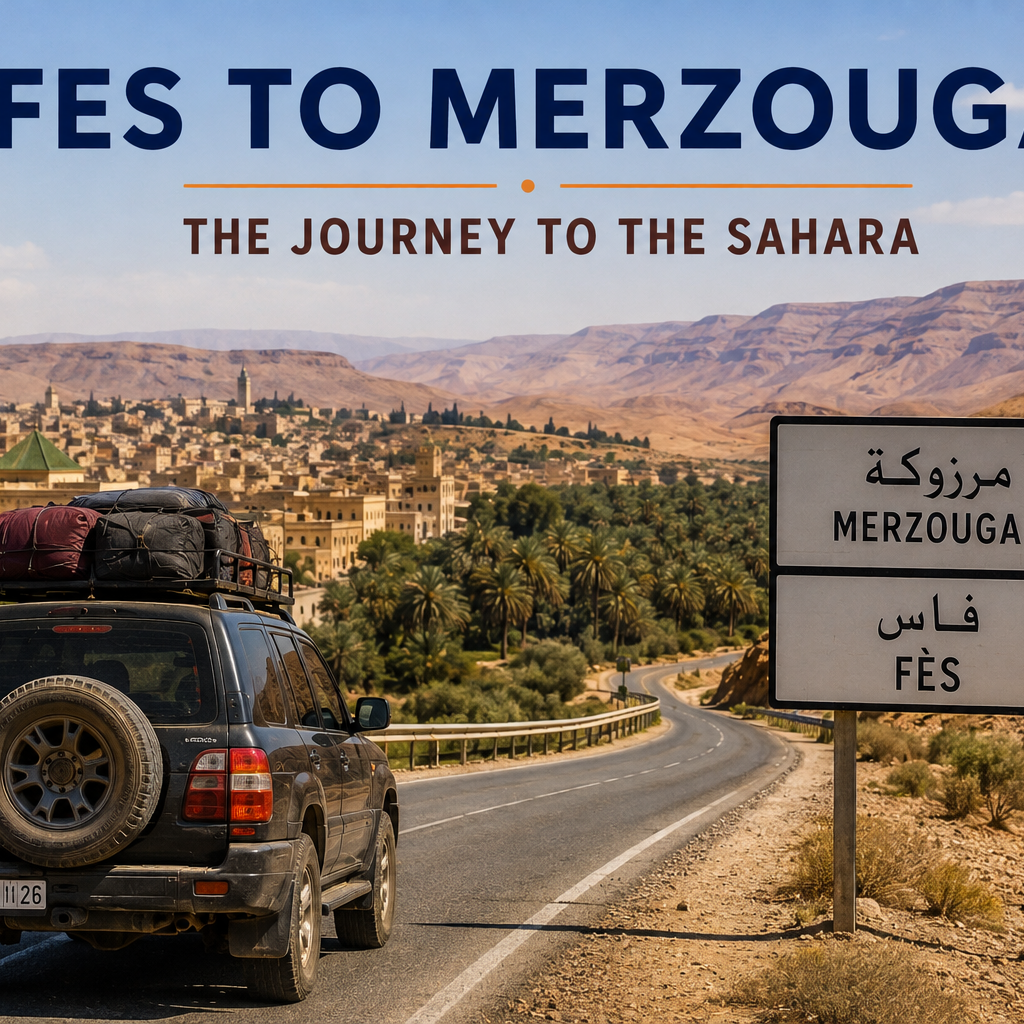
Realistically, this is still a long single-day drive, and many travelers break it into two days with a stop around Midelt or the Ziz Valley, giving a chance to see the cedar forests near Ifrane and Azrou and the palm groves of the Ziz Valley rather than just passing through. A multi-day Fes to Merzouga tour is a common way to cover this route with stops already planned in.
Ouarzazate to Merzouga
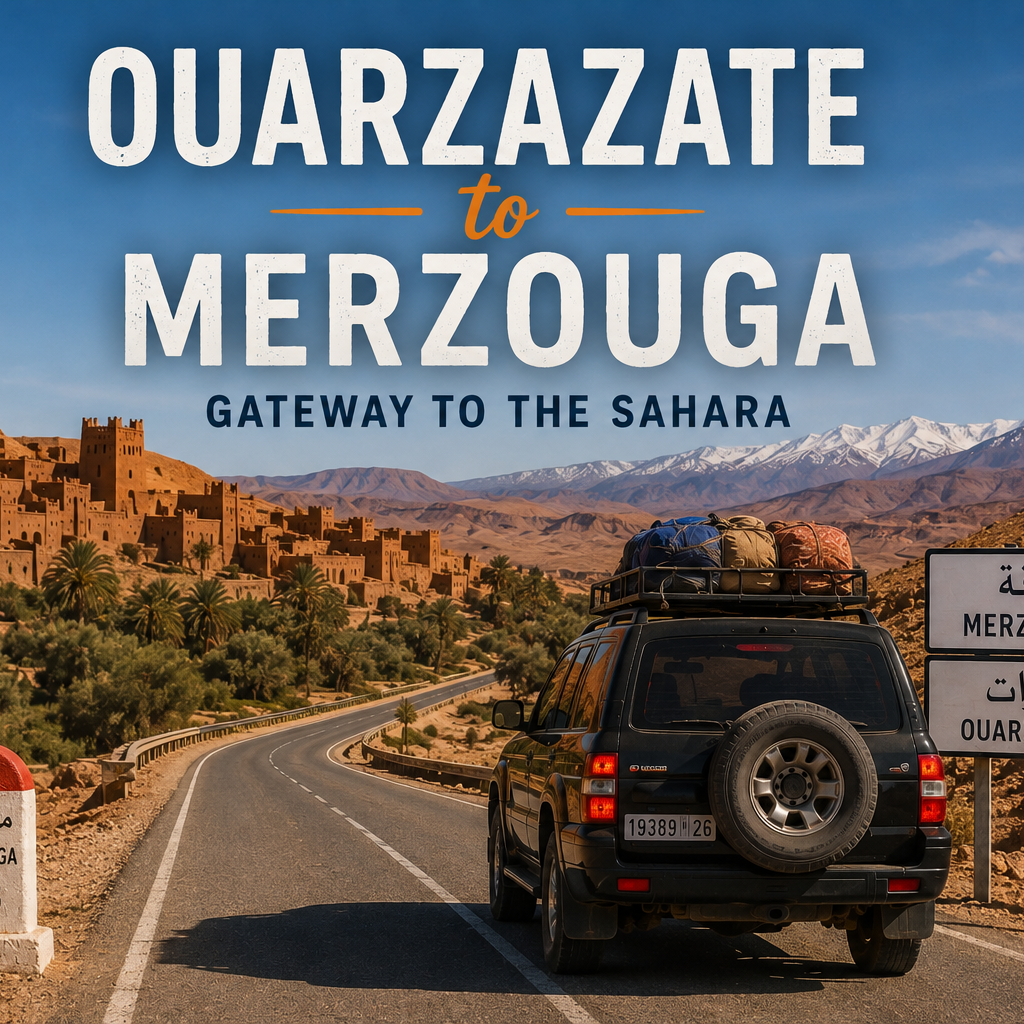
If you’re already in Ouarzazate — often the case for travelers touring the film studios, kasbahs and central Morocco first — Merzouga is roughly 360 km away, around 5 to 6 hours of driving via Tinghir and the Todra Gorge, or via the more southerly Alnif/Rissani route. This makes Ouarzazate a genuinely useful midpoint gateway, shorter than starting fresh from Marrakech.
- Rental car: Straightforward and paved the whole way; a good option if you’re comfortable navigating and want to stop freely at the gorges.
- Private transfer: A practical middle ground if you’d rather not drive but still want a direct, flexible schedule.
- Organized tour: Common as part of a longer Morocco itinerary, often continuing on from a Marrakech or Fes departure.
- Off-road tour: Where a route genuinely leaves paved roads (for scenic detours rather than the direct road itself), a 4×4 off-road tour from Ouarzazate is worth considering — this is different from needing a 4×4 simply to reach Merzouga, which you don’t.
Casablanca to Merzouga
Casablanca is Morocco’s main international gateway for many travelers, but it’s also the least convenient starting point for Merzouga — there’s no direct short route. You’re effectively looking at Casablanca–Marrakech (roughly 240 km, about 2.5–3 hours on the highway) plus the full Marrakech–Merzouga leg on top, or a similar combination via Fes. Driven end-to-end, that’s a very long single push — more realistically split across two or three days.
Three practical alternatives for travelers starting in Casablanca:
- Fly Casablanca to Errachidia, then transfer the remaining 120–130 km — the fastest option if a suitable flight is available, though frequency is limited and should be checked directly with the airline before relying on it.
- Travel to Marrakech or Fes first (by train or domestic flight, both well-connected from Casablanca), then continue to Merzouga using any of the options described above — often the more reliable choice given how infrequent Errachidia flights can be.
- Book a multi-day tour departing from Casablanca or Marrakech, which builds the long first leg into a planned itinerary with overnight stops rather than treating it as a single transfer.
Getting to Merzouga by Rental Car
Self-driving is a genuinely good option for Merzouga — every main route (from Marrakech, Fes, Ouarzazate or Errachidia) is paved the entire way to Merzouga village and Erg Chebbi’s edge. Here’s what to actually plan for:
- Road quality: Main routes are sealed, well-maintained highways and national roads, though mountain sections (especially the Tizi n’Tichka pass) involve winding roads with sharp turns and, at higher elevations, occasional winter ice or snow.
- Navigation: Offline maps are worth downloading in advance, since mobile signal drops in stretches of the Atlas and pre-Sahara zones.
- Fuel planning: Fill up in larger towns (Ouarzazate, Tinghir, Errachidia, Erfoud) rather than assuming you’ll find a station exactly when you need one — stretches between towns can be long.
- Parking: Most hotels and guesthouses in Merzouga village have private parking; desert camps typically have a designated parking or meeting point rather than parking beside the tent itself (see the camp access section below).
- Night driving: Arriving after dark on unfamiliar mountain roads is genuinely worth avoiding if you can help it — unlit roads, occasional livestock on the road, and unfamiliar hairpin turns are a harder combination at night. Plan your departure time to arrive with daylight to spare.
- Freedom: The clear advantage — you set your own pace, stop wherever looks interesting, and aren’t tied to anyone else’s schedule.
Advantages: Full flexibility, ability to stop for photos and detours, no dependence on transfer or tour timing. Disadvantages: Requires confidence with mountain driving and Moroccan road norms, and mistakes in route timing fall entirely on you. Compare rental options through our Merzouga car rental page, and if you’re unsure whether you actually need a 4×4 for this trip, see the dedicated section further down and our full 4×4 guide.
Getting to Merzouga by Private Transfer
A private transfer is the middle-ground option: you get a fixed, direct journey on your own schedule, without driving it yourself. A driver picks you up at your airport, hotel or riad and takes you directly to Merzouga (or your desert camp’s meeting point), typically with the option to request a stop or two along longer routes.
This suits travelers who want the flexibility of a direct, private schedule but don’t want to navigate unfamiliar roads themselves — families with young children, travelers arriving tired from a long flight, anyone short on time who still wants a direct (not shared) journey, and those who’d simply rather relax and look out the window on the Marrakech or Fes route. It typically costs more than a rental car or bus, but less than assembling the same flexibility through a fully custom tour. You can arrange transfers for the Errachidia route directly through our Errachidia Airport private transfer guide, or via the general transfer search page for other routes.
Traveling to Merzouga by Bus
Long-distance coach operators — mainly Supratours and CTM — run routes connecting major Moroccan cities toward the Tafilalt region, typically to Er-Rachidia and/or Rissani. There is no direct long-distance coach station in Merzouga village itself on the main network, so bus travelers generally finish the trip with a short local taxi or pre-arranged transfer (roughly 20–30 minutes) from Rissani or Erfoud into Merzouga.
This is the cheapest way to cover the distance, but it takes considerably longer than a private transfer or rental car covering the same route, since coaches make scheduled stops along the way. Schedules and fares can change, so verify directly with Supratours or CTM before traveling — don’t plan a tight connection or a same-day onward transfer around a schedule you haven’t confirmed. If you’re budget-conscious but want more certainty on timing, a shared or budget group tour can sometimes be a more predictable alternative to a solo bus-plus-taxi combination.
Traveling to Merzouga With an Organized Tour
An organized tour is meaningfully different from a private transfer, even though both involve someone else doing the driving. A transfer is point-to-point transportation; a tour builds the journey into the experience — stops at Aït Ben Haddou, the Dades and Todra Gorges, local guiding, and often an overnight along the way — before ending with a night or more in the desert itself.
Advantages: Logistics, driving, route planning and sightseeing are all handled for you, and multi-day itineraries let you actually experience the regions you’re passing through rather than just transiting them. Disadvantages: Less flexible than self-driving — you follow a set schedule and set stops, and solo travelers share the vehicle with a small group on standard tours (private tours cost more but restore that flexibility). Who it suits: First-time visitors to Morocco, solo travelers who’d rather not drive alone, and anyone who wants the Atlas crossing and desert to feel like one connected trip rather than a transfer followed by a separate destination. Browse current options on our Merzouga desert tours page.
Can You Reach Merzouga With a Normal Car?
Yes. Every main route to Merzouga — from Marrakech, Fes, Ouarzazate or Errachidia — is fully paved, and a standard rental car or normal passenger vehicle can drive the entire way to Merzouga village and the paved edge of Erg Chebbi without any need for four-wheel drive.
Where a normal car reaches its limit is the sand itself: driving directly onto the dunes, or along soft, unpaved tracks to certain camps set further into Erg Chebbi, isn’t something a standard rental car can safely do — and most rental agreements explicitly prohibit off-road or unpaved driving. That’s a separate question from getting to Merzouga, and it’s covered in full in the next section.
Do You Need a 4×4 in Merzouga?
No — not to get to Merzouga. A 4×4 only becomes genuinely useful once you’re driving off the paved road: onto the dunes themselves, along soft sandy tracks to a handful of remotely situated camps, or on secondary tracks after rain. These are two separate questions that are easy to conflate:
- Getting TO Merzouga — a normal car handles this on every main route, no exceptions.
- Driving OFF-ROAD around Merzouga — into the dunes, to a camp set in the sand, or on rough secondary tracks — is where a 4×4 (ideally with an experienced local driver) actually matters.
Most independent travelers never need to drive a 4×4 themselves at all — the final stretch into the dunes to reach a camp is usually handled by the camp’s own vehicle or a camel transfer, covered next. For the complete picture, including rental restrictions and when a self-driven 4×4 genuinely makes sense, see our full guide to whether you need a 4×4 in Merzouga.
How Do You Reach a Desert Camp?
Reaching Merzouga village doesn’t automatically mean you can drive directly to your desert camp — many camps sit inside Erg Chebbi itself, on sand a normal car can’t cross. The typical arrangement works like this:
- Meeting point: Camps usually specify a fixed meeting point in Merzouga village, or ask you to arrive at a hotel/parking area on the edge of the dunes.
- 4×4 transfer: From there, many camps send their own 4×4 to carry you (and your luggage) the rest of the way across the sand.
- Camel transfer: Some camps — often as part of the experience itself — bring guests in by camel trek instead, particularly for sunset arrivals.
- Parking: If you’ve driven yourself, you’ll typically leave your car at the meeting point or a guarded parking area rather than driving it onto the sand.
Arrangements vary by camp, and this is exactly the kind of detail worth confirming directly with your accommodation before you travel — ask specifically how you’ll be met, where you should leave a rental car, and what happens if you’re arriving after dark. For accommodation options and what each style typically includes, see where to stay in Merzouga.
Best Option by Traveler Type
| Traveler | Best Option | Why |
|---|---|---|
| First-time visitor | Multi-day organized tour | Handles logistics, driving and sightseeing together with no route-planning needed |
| Couple | Private transfer or short tour | Comfortable pace without the pressure of self-navigating unfamiliar roads |
| Family with children | Private transfer, or fly + transfer if starting from Casablanca | Minimizes total hours in the car and avoids unpredictable public transport timing |
| Solo traveler | Organized tour or bus + local transfer | More sociable, and avoids long solo driving on unfamiliar mountain roads |
| Budget traveler | Bus to Rissani/Er-Rachidia + local transfer | The lowest-cost way to cover the distance, if you have flexible time |
| Road-trip traveler | Rental car via Marrakech or Fes route | Full control to stop at Aït Ben Haddou, the gorges, and anywhere else that looks interesting |
| Luxury traveler | Private transfer (or flight + transfer) to a pre-booked luxury camp | Minimizes transit time and hands off all logistics |
| Short-stay traveler | Fly to Errachidia + private transfer | Cuts a 9+ hour overland trip down to a few hours, if a suitable flight exists |
| Photography traveler | Rental car or small private tour | Freedom to time stops at the pass, gorges and dunes for the right light |
Mistakes to Avoid When Traveling to Merzouga
- Underestimating driving time. 9–11 hours from Marrakech (or 7–9 from Fes) is real driving time, not including stops, fuel, or traffic through towns — build in a buffer.
- Driving long, unfamiliar routes late at night. Unlit mountain roads, hairpin turns and occasional livestock make night driving on these routes genuinely riskier than the same road in daylight.
- Assuming every desert camp is accessible by normal car. Many aren’t — confirm your camp’s meeting point and transfer arrangement before you arrive, not after.
- Failing to confirm camp meeting points in advance. Arriving in Merzouga after dark with no confirmed pickup point is a common, avoidable problem.
- Not checking current bus schedules. Coach schedules and fares change; verify directly with the operator rather than relying on an old timetable found online.
- Poor fuel planning. Don’t assume a fuel station will appear exactly when you need one on the longer stretches between towns.
- Overloading a Marrakech–Merzouga itinerary. Trying to see Aït Ben Haddou, the Dades Gorge, the Todra Gorge and Merzouga all in one rushed day usually means seeing none of them properly.
- Relying blindly on online estimated travel times. Route-planning apps often underestimate mountain-road driving time — treat their numbers as a starting point, not a guarantee.
Final Recommendation
Fastest practical option: Flying to Errachidia and transferring in, if a suitable flight is available — it cuts a 9+ hour overland trip down to a couple of hours total, though you’ll need to verify current flight frequency.
Best for flexibility: A rental car, since you control every stop, pace change and schedule adjustment yourself.
Best for sightseeing: The Marrakech route (self-driven, transferred, or toured) split across two days, so Aït Ben Haddou, the Tizi n’Tichka pass and the gorges become part of the trip rather than something you drive past.
Best for comfort: A private transfer — direct, door-to-door, with no navigation or driving fatigue involved.
Best budget option: A long-distance bus to Rissani or Er-Rachidia followed by a short local transfer into Merzouga — the least expensive way to make the trip, provided you have flexible time and confirm schedules in advance.
Plan Your Journey to Merzouga
Once you’ve settled on how you’re getting to Merzouga, the next practical steps are booking it and deciding where you’ll stay. If you’re driving yourself, compare options on our Merzouga car rental page. If you’d rather have someone else handle the driving, arrange a private transfer, or browse multi-day desert tours that build the journey and the destination into one itinerary. And once your transport is sorted, our where to stay in Merzouga guide covers guesthouses and desert camps so you know exactly where you’re headed.
Frequently Asked Questions
What’s the best way to travel to Merzouga?
It depends on your starting point, budget and time: a private transfer or rental car from Marrakech or Fes suits most travelers, flying to Errachidia plus a transfer is fastest if you’re short on time, and a bus plus local transfer is the cheapest option if you have flexibility to spare.
What airport is closest to Merzouga?
Errachidia Airport (ERH) is the closest, around 120–130 km away, but it has limited flight frequency. Marrakech, Fes and Ouarzazate airports have far more flight connections and are commonly used as the practical gateway instead.
How do I get from Errachidia Airport to Merzouga?
By private transfer, taxi, or rental car — all around 1.5 to 2 hours for the roughly 120–130 km journey. Pre-booking a transfer is recommended, since car rental counters and taxi availability at this small airport can be limited.
Can you drive to Merzouga with a normal car?
Yes. Every main road to Merzouga from Marrakech, Fes, Ouarzazate or Errachidia is fully paved, and a standard rental car can make the entire trip without needing four-wheel drive.
Do you need a 4×4 for Merzouga?
Not to reach Merzouga itself. A 4×4 only becomes useful once you leave the paved road — driving on the dunes, reaching a camp set in the sand, or using rough secondary tracks after rain.
How do I get from Marrakech to Merzouga?
By private transfer, rental car, bus, or organized tour, covering roughly 560 km via the Tizi n’Tichka pass, Ouarzazate and the Dades/Todra Gorge region — typically 9 to 11 hours of driving, often split across two days.
How do I get from Fes to Merzouga?
By private transfer, rental car, bus, or organized tour, covering roughly 470 km via Ifrane, Midelt and Errachidia — typically 7 to 9 hours of driving.
Is there a bus to Merzouga?
Long-distance coaches (Supratours, CTM) run toward Er-Rachidia and Rissani, with a short local taxi or transfer needed for the final stretch into Merzouga itself. Schedules and fares change, so verify directly with the operator before traveling.
Is the road to Merzouga paved?
Yes, every main route — from Marrakech, Fes, Ouarzazate and Errachidia — is fully paved all the way to Merzouga village and the edge of Erg Chebbi.
Is it safe to drive to Merzouga?
Generally yes on the main paved routes, provided you’re comfortable with mountain driving, avoid arriving after dark on unfamiliar roads, and plan fuel stops in advance. As with any road trip, conditions and safety depend on the season, weather and your own driving experience.
How many days do you need for Marrakech to Merzouga?
Most travelers take two to three days each way, stopping to see Aït Ben Haddou, Ouarzazate and the Dades or Todra Gorges rather than driving the full 9–11 hours in one push.
Can I drive directly to a Merzouga desert camp?
Usually not all the way. Most camps sit inside Erg Chebbi’s sand, so you’ll typically park at a meeting point in Merzouga village and continue by the camp’s own 4×4 or camel transfer — confirm the exact arrangement with your accommodation before you travel.